A Social Robot Ecosystem Supporting Informal Caregiving at Home
GUARDIAN developed a modular social robot ecosystem designed to support informal caregivers of older adults living at home. By combining robotic interaction, life-pattern monitoring and cloud-based services, the project aimed to provide reassurance, structure and timely information to those supporting ageing relatives from a distance.
Starting from the Needs of Informal Caregivers
GUARDIAN was conceived in response to a growing challenge faced by informal caregivers: supporting older relatives who live alone while balancing work, family responsibilities and geographic distance. Rather than focusing solely on the older person as a user, the project explicitly addressed the needs of caregivers who seek reassurance that daily routines are maintained and potential risks are detected early. The solution was designed to reduce uncertainty and emotional stress by providing contextual information without requiring constant physical presence.
A Modular Robot Ecosystem Rather Than a Single Device
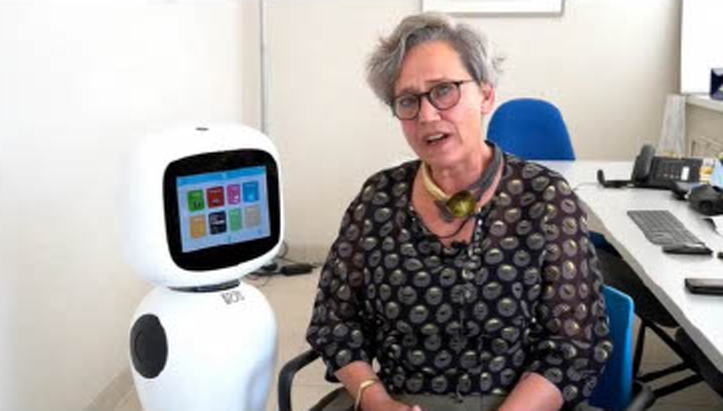
Instead of developing a single-purpose robot, GUARDIAN created an open and modular ecosystem. The Misty II robot served as one possible embodiment, while a cloud-based backend enabled remote access, configuration and personalisation. Modules supported daily structure, reminders, social interaction and the detection of deviations from usual activity patterns. This architecture allowed caregivers to stay informed about routines and potential issues, while older adults interacted with the system in a non-intrusive way. The modular approach also enabled partners to develop and refine components independently.
Co-Design with Care Networks and Ethical Reflection
User involvement extended beyond older adults to include informal caregivers and care organisations. From early needs assessments to iterative testing, caregivers contributed insights on what information is helpful, when alerts become intrusive and how technology can support rather than replace human care. Ethical and responsibleinnovation considerations were integrated into these co-design processes, ensuring that monitoring functions respected – among others – privacy and autonomy while still providing meaningful reassurance to caregivers.
Impact Beyond the Project Through Multiple Care-Oriented Pathways
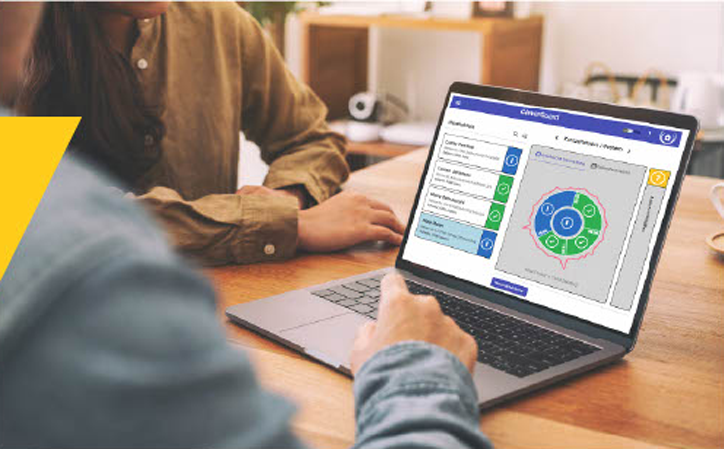
Although GUARDIAN was not commercialised as a single product, its components continued to evolve after the project ended. Smartrobot.solutions integrated the platform into commercially available care robots used in residential and community settings. ConnectedCare developed Lizz, a digital health care assistant offering similar caregiver-oriented functionality and now available on the market. Additional derivatives, such as companion robots like the Maatje robot and Maatje pop of Smartrobot.solutions, further illustrate how GUARDIAN’s architecture supports different caregiving contexts. These outcomes demonstrate that caregiver-centred value can be realised through modular transfer rather than direct product launch.
Lessons on Sustainability in Informal Care Contexts
The project highlighted both the potential and the limits of robotics in informal care. Fragmented care markets, reimbursement uncertainty and reliance on nonEuropean hardware platforms complicate large-scale adoption. At the same time, the coordinator emphasised the long-term value of AAL participation in building trusted networks, advancing responsible innovation practices and strengthening organisational capacity. GUARDIAN shows that solutions addressing informal caregivers’ needs may achieve impact through gradual integration into existing services rather than immediate commercial scaling.
Project Info
GUARDIAN was an AAL project developing a modular social robot ecosystem to support informal caregivers of older adults living at home. Coordinated by Vilans, the project combined robotics, cloud services and co-creation. Several components have since been integrated into caregiver-oriented products and services.